Tour highlights solar’s success in Moffat, Routt counties
Installations at 13 public locations credited with providing $1.34M in savings

Suzie Romig Follow
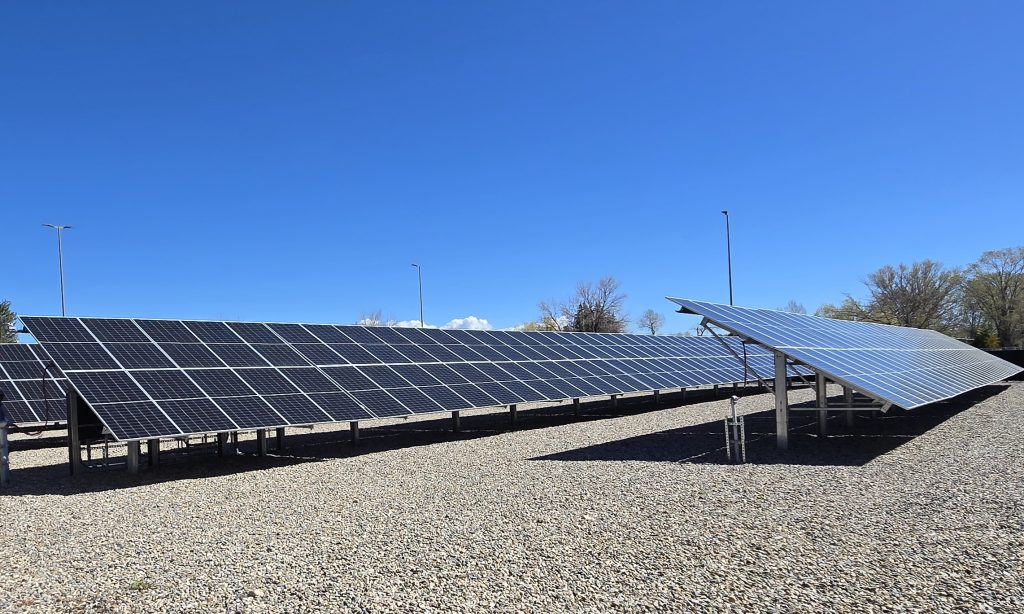
Suzie Romig/Craig Press
In celebration of more than four years of successful energy production and electricity cost savings, municipal staff members, construction partners and community members gathered Tuesday for a multi-stop Yampa Valley Solar Corridor Tour.
Led by energy services company McKinstry and nonprofit Colorado Public Interest Research (CoPIRG) Foundation, tour speakers outlined how the commercial-scale solar installations at 13 public locations across Moffat and Routt counties have so far provided more than $1.34 million in electricity bill savings.
“We want to celebrate these projects and also lift them up as examples,” said Kirsten Schatz with CoPIRG, a statewide consumer advocacy group that stands up for the public interest in health, safety and well-being matters. “We want to see more projects like these in Colorado, and plant some seeds in other communities.”
From Craig to Steamboat Springs and Yampa, the installations, mostly built on vacant land adjacent to high electric-use facilities, utilize the sun’s rays to produce electricity through a combined 2,266 kilowatt capacity. The large ground-mounted systems or installations on roofs have created operational savings for a variety of city, county and school facilities.
Roy Tipton, former Moffat County director of development services and now an independent consultant, said that the 207kW solar array at the Moffat County Courthouse saves the county at least $30,000 per year in avoided energy costs. Tipton said the array on the east side of the courthouse was paid for upfront through grants and now covers at least 40% of the courthouse’s electricity needs, including the largest electric cost — air conditioning.
Carl Ray, Craig water and wastewater director, said production of the combined 465kW solar installations at the city’s water and sewer plants benefit customers by helping to keep rates under control. Ray said processing plants use a large amount of energy and that the solar field performance “has been as good or better than expected.”

“Any revenue that we can save, that savings is passed along to our customers,” Ray said. “It’s a very important project to offset some of our energy usage.”
All but one of the 13 solar projects at the public facilities shepherded by McKinstry were completed in November or December 2021. The fenced-in solar array at the Moffat County Courthouse was completed in August 2023.
The initial solar projects in 2021 cover portions of electricity needs for the Moffat County Safety Center, Moffat County High School, Craig Water Treatment Plant, Hayden Police Station, Hayden Community Center, Steamboat Transit, town halls in Oak Creek and Yampa, Yampa Valley Regional Airport, and wastewater treatment plants for Craig, Hayden and Steamboat Springs.
The 13 solar projects so far have produced enough energy to power about 1,660 average Colorado homes for one year and have avoided large amounts of harmful air pollution including 24.9 million pounds of carbon dioxide, according to McKinstry and CoPIRG.
The solar celebration tour started in a field of ground-mounted solar panels east of the Yampa Valley Electric Association office in Craig. Completed in late 2023 by energy company Ameresco, that solar array spans 20 acres and has generated more than 22.5 million kilowatt-hours of energy since its completion, an amount that can power more than 2,100 average American homes for one year, Schatz said.
The success of the solar arrays in Moffat and Routt counties show why other Colorado communities should pursue solar before federal tax credits expire in 2027, Schatz said, and how other projects starting soon could be considered as a “safe harbor” for incentives for up to four years.
“The window for federal tax credits for commercial-scale solar installations is starting to close,” said Martin Beggs, McKinstry renewable energy project director. “Communities that act quickly can still secure federal funding covering 30% or more of the total cost for their solar projects.”
The federal Investment Tax Credit for solar allows nonprofit organizations and public entities to receive funding through direct payments.
Ashley Brasovan, McKinstry senior energy account executive, explained how the 13 solar installations were offset in construction costs through $2.1 million in energy impacts funds through the Colorado Department of Local Affairs, which brought the project payback timeframe to 11 years. Commercial solar arrays have an average 30-year lifespan before panels need to be replaced, Beggs said.
“Some stakeholders paid cash and are pocketing all savings, while others financed the arrays and are paying back through the energy savings,” Brasovan explained.
Brasovan said some public entities in Colorado working to install their own renewable energy projects are now investigating geothermal and battery storage options that have federal tax incentives extending through 2032.
She explained that many electric co-operatives outside of Xcel Energy have aligned with the state-allowed net-metering commercial solar cap per meter of 25kW. Many of the existing 13 arrays were built at an advantageous time to construct larger sizes for efficiency, and only the Oak Creek and Yampa town hall installations are small enough to land under the current caps.
Experts on the tour said construction of cost-effective. commercial-scale solar projects are now less financially feasible within the Yampa Valley Electric Association territory with the current 25kW-per-meter commercial net-metering cap, which was downsized by YVEA co-op leadership from a previous 150kW per meter cap in November 2022. Smaller projects are more expensive per installed watt than a large solar field, the experts explained.
“The real challenge is, reducing that to 25kW means you’re never going to see another commercial field like this,” Tipton said standing at the courthouse array. “Because, for us, 25kW isn’t worth doing.”
Schatz remains positive about the benefits of solar arrays, especially when coupled with battery storage, particularly considering weather-related power outages and rising utility bills.
“We should be doing as much as we can to take full advantage of the clean, free fuel from the sun,” Schatz said, “and these projects here in the Yampa Valley are excellent examples of that.”










Support Local Journalism
Support Local Journalism
Readers around Craig and Moffat County make the Craig Press’ work possible. Your financial contribution supports our efforts to deliver quality, locally relevant journalism.
Now more than ever, your support is critical to help us keep our community informed about the evolving coronavirus pandemic and the impact it is having locally. Every contribution, however large or small, will make a difference.
Each donation will be used exclusively for the development and creation of increased news coverage.