Colorado River projected to deliver one-fifth of normal water to Lake Powell after ‘astonishing’ March heatwave
The record-hot March conditions that led to a rapid melt-off of the snowpack in Colorado were echoed across the seven-state Colorado River Basin

Ryan Spencer Follow
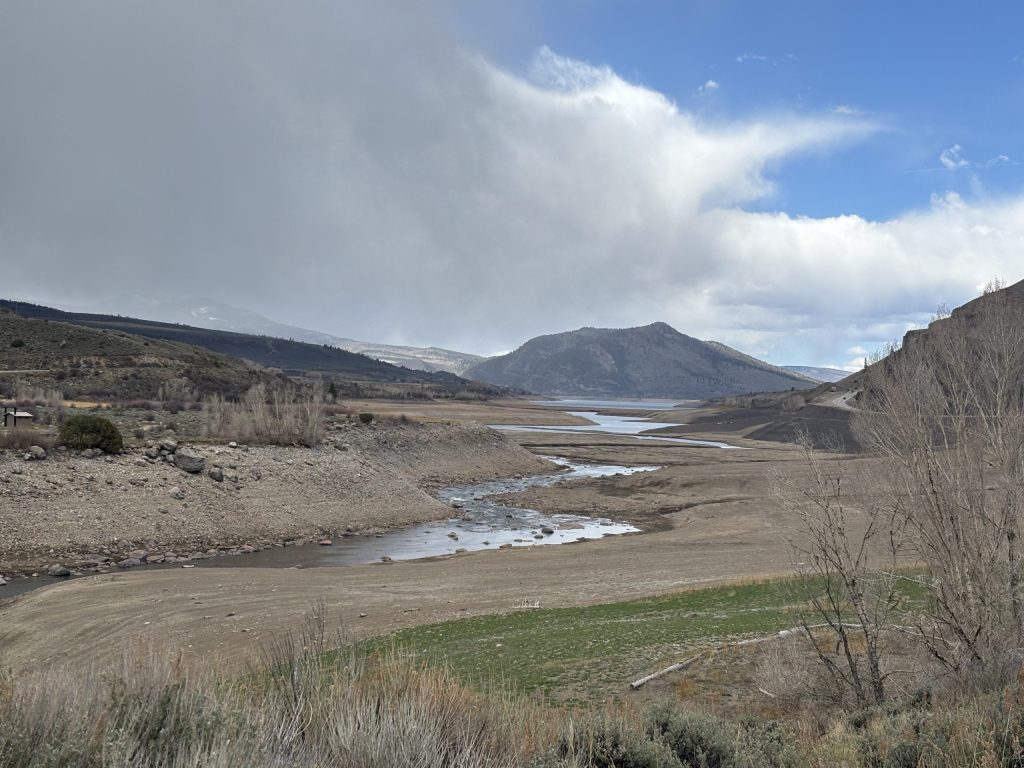
Ryan Spencer/The Aspen Times
An unprecedented March heatwave has forecasters shrinking already-low estimates for how much water will flow into the Colorado River during spring runoff, which is already well underway this year.
The latest models show that the Colorado River is projected to deliver only about 1.4 million acre feet of water — roughly one-fifth of normal — to Lake Powell, the nation’s second-largest reservoir.
Colorado River Basin Forecast Center hydrologist Cody Moser said during a water briefing on Tuesday, April 7, that if those projections were to bear out, it would be the third lowest amount of water delivered to Lake Powell in the reservoir’s 63 year history.
“We are on the extreme end of things,” Moser said. “We had a huge heatwave at the end of March with significant snowmelt.”
The Colorado River Basin spans seven states and two countries, serving as the water supply for 40 million people. Lake Powell, which is currently just 23% full, acts as a “bank account” of water that Lower Basin states can draw from during dry years and upper basin states add to after using their share of the Colorado River, according to the U.S. Bureau of Reclamation. The entire basin has experienced ongoing shortages amid a water crisis in recent years.
This season’s increasingly dire projections for the Colorado River come at a critical junction. The Colorado River Basin states failed to reach an agreement by a crucial deadline earlier this year, kicking the question of how to manage the river and its reservoir system to the federal government.
At the start of March, snowpack across the Colorado River Basin and projections for the spring runoff were already low, raising concerns of water shortages and an early start to what could be a dangerous fire season across the West.
Then came a “very dry March” with a record-shattering heatwave that melted large amounts of the snowpack from the “most crucial areas for spring runoff,” Moser said. Nearly all of these areas had less than 50% of average precipitation in March, and have seen less than half of the average precipitation since October, he said.

“Especially during the last half of March, it got extremely warm,” Moser said. “The heatwave moving through melted a bunch of snow. … It was the warmest March on record across the Southwest.”
The Colorado Climate Center reported that March was the warmest in the state’s 132-year record “by a large margin.” This past March, in fact, was hotter than 90% of past Aprils and set 227 new monthly high temperature records across the state, according to the center’s monthly climate summary. Scientists with World Weather Attribution have determined that the heatwave would have been “virtually impossible” without the influence of human-caused climate change, driven by the burning of fossil fuels.
Averaged across Colorado, March was an “astonishing” 13 degrees Fahrenheit warmer than the 20th century average, almost 10 degrees warmer than the 1991-2020 average and more than 4 degrees warmer than any previous March, according to the state’s monthly climate summary.
Large parts of the mountains experienced record-breaking temperatures lasting for days on end and leading to a rapid melt-off of the state’s already historically-low snowpack. Colorado started April with a snowpack that state climatologists said was the worst in at least the past 75 years.
Colorado’s snowpack peaked in early March — a full month earlier than normal — at 8.5 inches of snow-water equivalent, or roughly half of the 30-year median, according to the state’s snow telemetry data.
Normally, the state’s snowpack peaks on April 8, but by the time that date rolled around this year, the data show the statewide snowpack had declined to just 3.6 inches of snow water equivalent. That’s less than half what it was a month earlier, and just 23% of normal for that point in the season.
The March melt-off and record-low snowpack conditions were matched across the Colorado River Basin. As of April 1, snowpack across the Western mountains that melt into the Colorado River was generally less than 25% of normal, Moser said. He noted that the conditions have led to significantly lower water supply forecasts.
According to the most recent models, the Yampa River is only expected to deliver 30% of the average amount of water to the Colorado River system this spring and summer, which would be the second lowest in 42 years, Moser said. The Colorado River Headwaters Basin, a sub-basin in north-central Colorado, is only expected to supply about 40% of the average amount of water to the larger Colorado River Basin, which would be the third lowest amount in 93 years, he said.
Most of the Colorado River Basin can expect between one to two inches of precipitation this weekend, Moser said. Meanwhile, the National Oceanic and Atmospheric Administration’s eight to 14 day outlook predicts wetter-than-normal conditions across the West. Offering, “a little bit better news,” he added that above-average soil moisture across the region could increase how efficiently this precipitation and any additional snowmelt runs off into streams and reservoirs.








Support Local Journalism
Support Local Journalism
Readers around Craig and Moffat County make the Craig Press’ work possible. Your financial contribution supports our efforts to deliver quality, locally relevant journalism.
Now more than ever, your support is critical to help us keep our community informed about the evolving coronavirus pandemic and the impact it is having locally. Every contribution, however large or small, will make a difference.
Each donation will be used exclusively for the development and creation of increased news coverage.