Colorado lawmakers make bipartisan call for Trump to grant federal aid for wildfires after previous denials
U.S. Sen. Michael Bennet said denial of federal aid for last year’s disasters was part of “Trump’s political vendetta” against the state
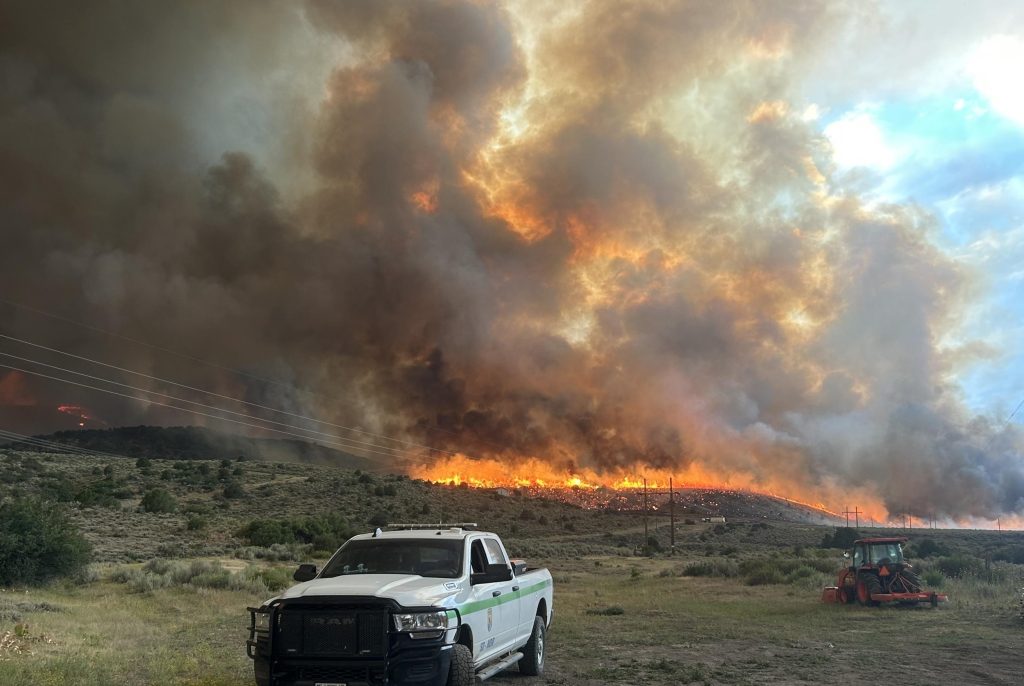
Elk and Lee Fire InciWeb/Courtesy photo
Colorado Gov. Jared Polis is requesting a major disaster declaration from President Donald Trump and the Federal Emergency Management Agency, just months after the administration denied similar requests for disaster recovery aid.
The state’s entire congressional delegation sent a letter on Monday, supporting the major disaster declaration requests for the Aspen Acres and Gold Mountain fires. The letter was bipartisan with support from Republican U.S. Reps. Jeff Hurd, Lauren Boebert, Jeff Crank and Gabe Evans, as well as Democratic Sens. Michael Bennet and John Hickenlooper and U.S. Reps. Joe Neguse, Brittany Pettersen, Diana DeGette and Jason Crow.
A major disaster declaration — which can only be made by the president — unlocks federal assistance programs that the letter says “are indispensable to recovery, mitigation and long-term resilience.”
The Aspen Acres Fire has destroyed 324 homes across Pueblo and Custer counties, making it Colorado’s fifth most destructive fire ever by homes lost, according to the state government. More than 11,000 residents across three counties were under mandatory evacuations at the height of the fire, which burned more than 100,000 acres and is now 74% contained.
The Gold Mountain Fire has burned almost 40,000 acres northeast of Ouray and is currently 87% contained.
Both fires were discovered in late July. While the extreme fire behavior seen earlier this summer has died down, recent rain has led to flash flooding and debris flows in the burn scars from the fires.
Heavy rainfall over the Aspen Acres Fire burn scar killed a local resident earlier this month. In late July, emergency responders also had to rescue 17 people caught in debris flows after rain fell over the burn scar at the Gold Mountain Fire, according to the state government. Three properties were reportedly deemed uninhabitable due to the damage.
“These communities urgently need federal relief to rebuild,” the congressional members’ letter states.
Presidential declarations are ‘critical’
Colorado Division of Homeland Security and Emergency Management Director Kevin Klein said that FEMA has validated at least $17 million in damages from the Aspen Acres and Gold Mountain fires, but he expects there to be another $6 million that could be validated later in the process.
Presidential disaster declarations open up access to public assistance — or programs to address damage to public infrastructure such as roads, electric lines or water systems — as well as individual assistance for those who had a home or business impacted by the disaster, Klein said. Individual assistance can help residents with temporary housing, rental assistance, unemployment and crisis counseling..
“They’re critical for these communities — especially when we’re talking about communities that are not very affluent, that have a lot of retirees in them, communities where counties don’t have a lot of money,” he said.
The Office of Emergency Management, which falls under the Colorado Division of Homeland Security and Emergency Management, coordinates with FEMA, state agencies and local jurisdiction to complete a joint preliminary damage assessment, he said. That damage assessment is then compared to eligibility criteria published by FEMA and validated by the federal agency.
“It’s really important just to understand that we’re doing the best we can to help the survivors and help the communities recover — no matter what,” Klein said. “… We’ll bring all of the resources we can, but really, additional federal assistance is really necessary. But with it or without it, we’re going to do whatever we can to help those communities.”
Questions linger about past disaster declaration denials
Colorado’s requests for a major disaster declaration for the Aspen Acres and Gold Mountain fires are the first the state has submitted since the Trump administration denied two other requests in December.
The requests for major disaster declarations for the Lee and Elk fires — more than 140,000 acres in Moffat and Rio Blanco counties — and historic flooding in southwestern Colorado last year also had the unanimous support of the state’s congressional delegation. According to state officials, it was the first time in 35 years that the federal government had denied the state’s request for a major disaster declaration.
Neither FEMA nor the White House Press Office returned a request for comment on Monday.
Bennet in a news release described the denial of the major disaster declarations for last year’s disasters as part of “Trump’s political vendetta against Colorado.” In the case of the Lee and Elk fires, FEMA verified $27 million damages including millions in damage to the White River Electric Association’s electrical infrastructure.
Bennet last week called on congressional leaders to investigate the Trump administration after a lawsuit unveiled a December email from a White House staffer inviting five federal agencies to a “brainstorm call” to “discuss immediate actions that (the administration) can take with respect to Colorado.”
The email was sent just hours before Trump attacked Colorado leaders for not releasing former Mesa County Clerk and Recorder Tina Peters from state prison, where she was being held after a jury found her guilty of election interference. Polis has since commuted Peters’ nine-year prison sentence, allowing her to be released on parole, which was met with a strong rebuke from his Democratic colleagues.
The denial of the major disaster declarations followed just days after the email was sent — as did other actions by the Trump administration, including attempts to dismantle the National Center for Atmospheric Research in Boulder and his veto of bipartisan legislation that would have completed the Arkansas Valley Conduit project that would bring clean drinking water to 50,000 Coloradans.
“No state should be subject to punitive measures for decisions that simply happen to go against a sitting president’s desires — and no American should be denied relief from floods and wildfires, or see their opportunity for clean water ripped away, simply because they happen to live in a state at odds with a given administration,” Bennet said in a statement.
Colorado lawmakers make bipartisan call for Trump to grant federal aid for wildfires after previous denials
Colorado Gov. Jared Polis is requesting a major disaster declaration from President Donald Trump and the Federal Emergency Management Agency, just months after the administration denied similar requests for disaster recovery aid.






Support Local Journalism
Support Local Journalism
Readers around Craig and Moffat County make the Craig Press’ work possible. Your financial contribution supports our efforts to deliver quality, locally relevant journalism.
Now more than ever, your support is critical to help us keep our community informed about the evolving coronavirus pandemic and the impact it is having locally. Every contribution, however large or small, will make a difference.
Each donation will be used exclusively for the development and creation of increased news coverage.