As the climate changes, will this year’s record-smashing heat become Colorado’s new normal?
The 2026 water year has seen numerous seasonal and monthly records when it comes to warmer-than-normal temperatures — and it’s not done yet

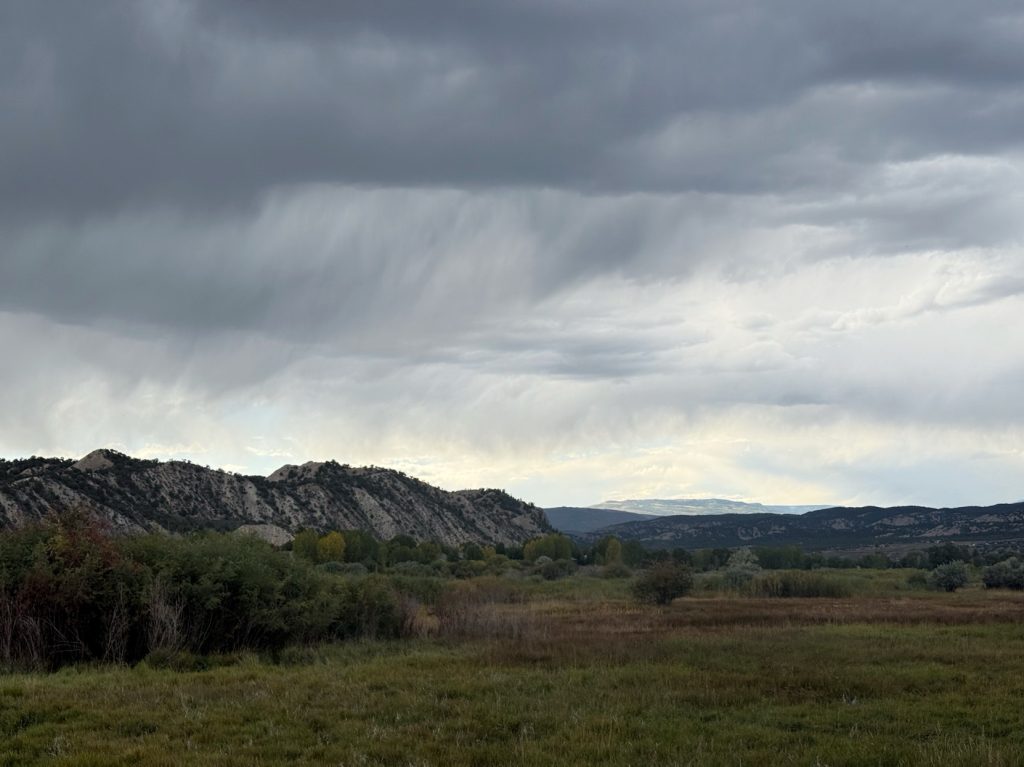
Ali Longwell/The Craig Press
While a few weeks remain in the 2026 water year, it has all but secured its place in the record books when it comes to one thing: the heat.
“It’s been a really warm stretch, a really warm water year,” said Colorado State Climatologist Russ Schumacher at the Tuesday, Sept. 22 Colorado Water Conditions Monitoring Committee meeting. “There are a lot of records that have been broken, and we will probably tally some more once we get the final numbers as the water year ends at the end of the month.”
With Colorado’s records dating back to the 1800s, Schumacher said this water year, which kicked off on Oct. 1, 2025, has brought the warmest December, February, March, August, winter, spring and summer statewide.
The Western Slope has accumulated almost the same records when it comes to heat, except for December and February, which were not the hottest on record, but the second and third, respectively.
And the records aren’t done stacking up yet.
“It’s going to be the warmest water year by a big margin,” he added.
Through the end of August, Schumacher said temperatures across the state were 5.6 degrees warmer than the average for the late 20th century. The previous record was set in the 1934 water year. By Aug. 31, average statewide temperatures for the 2026 water year were 2 degrees higher than the same 11-month period in 1934.
Statewide temperatures are also on track to make September the warmest on record, averaging 4-6 degrees warmer than normal as of Sept. 21, Schumacher said. While slightly cooler in the mountains, temperatures in western Colorado were still 2-4 degrees warmer than normal for the month.
“No matter how you slice the data here, it’s been extremely warm for a long stretch here in Colorado,” Schumacher said.
This year tracks alongside a bigger warming trend driven by human activities, including the burning of fossil fuels. A 2024 climate assessment from the Colorado Climate Center reported that statewide annual temperatures have increased by 2.3 degrees between 1980 and 2022.
However, it will be a while before years like 2026 become the “new normal,” according to Schumacher.
“This is so much above all those other years for just how persistent the warmth has been, that I don’t think we’ll see a repeat of this anytime that soon,” he said, adding that by the end of the century “these kinds of years probably do become closer to normal, but over the next couple of decades, it won’t become normal that quickly.”
Still, the odds of it happening will get greater and greater, he added.
“Warmer years are gonna become more common, because we’re getting warmer and warmer — warmer seasons, warmer years, warmer decades, they’re gonna keep getting more common,” Schumacher said. “And so the effects of the warming on drought are gonna continue to be more apparent, because we know that when it’s hot and dry, that increases the thirst for water, and you need more precipitation to keep the water supply at the same level when it’s so warm.”
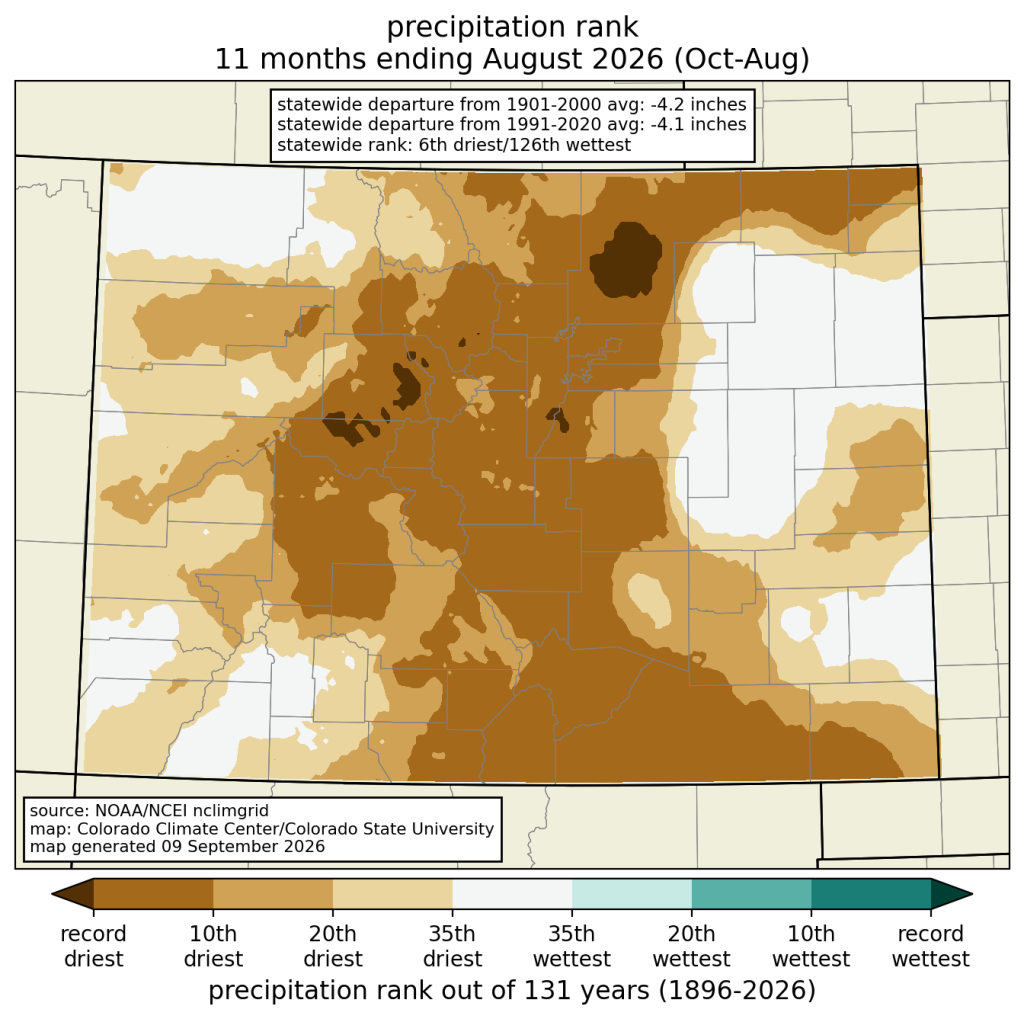
When it comes to precipitation, this water year has also been dry, although not to the same record-setting extent.
Statewide, the first 11 months of the 2026 water year rank as the sixth driest in the past 131 years. Certain pockets of the state — including parts of northern Pitkin County, eastern Eagle County, western Summit County and central Weld County — have experienced their driest Oct. 1-Aug. 31 on record.
There is some uncertainty around what climate change will do to precipitation and streamflow, Schumacher said at the Colorado River District’s annual seminar on Sept. 18. While this year was “an extreme example,” he added that with temperatures expected to rise, the melt-off of snowpack and streamflow peaks are likely to occur earlier in the year.
While Colorado’s record low snowpack this year, hitting 22% of normal, was also an extreme, a new study from the Colorado School of Mines concluded that this winter’s snow drought was “made four times more likely by human-caused climate change” and closer to 14 times more likely in the upper Colorado River basin.
“Our analysis shows that the 2026 snow drought was not simply bad luck,” said Adrienne Marshall, the study’s lead author, in a news release. “Human-caused warming substantially increased the likelihood of this event, particularly in the Colorado River headwaters that supply water to communities, agriculture and industry across the West.”
Marshall, who is an assistant professor in the Department of Geology and Geological Engineering at Colorado School of Mines, added that “the 2026 snow drought provides a tangible example of what the future would look like if greenhouse gas emissions continue to rise.”
The study concluded that while a year as severe as this one currently has a 10% chance of occurring in the West in any given year, the risk only increases. By the 2050s, this probability could triple with “moderately high greenhouse gas emissions.”
A shift for fall and winter
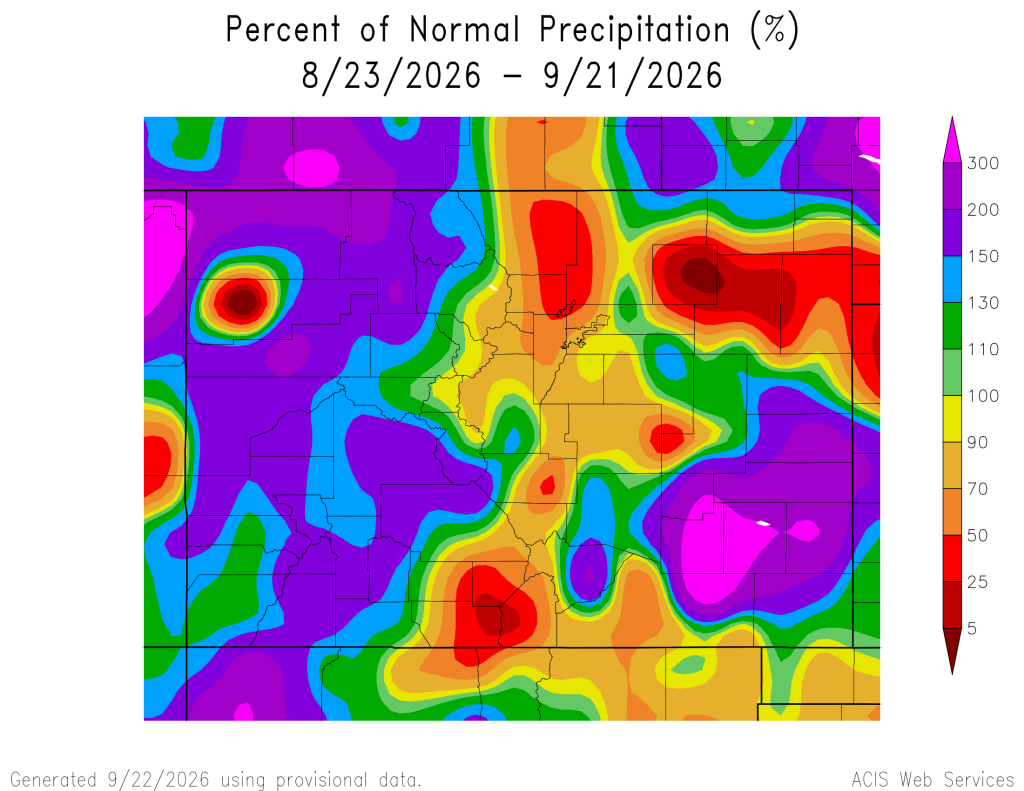
With there being some uncertainty in the longer-term, the arrival of El Niño and the end of an active monsoon season may spell some optimism in the next few months, even as drought conditions have persisted for Western Colorado over the last month,
“September, things have changed a little bit, where in a lot of the state, especially in western Colorado and parts of southeastern Colorado, September has been pretty wet up to this point,” Schumacher said.
According to the High Plains Regional Climate Center, precipitation during the past month has ranged from near normal to over 200% of normal for this time of year across the Western Slope, with the exception of a pocket of Rio Blanco County, which saw below-normal moisture.
This precipitation could be attributed to a few factors, according to Schumacher.
“The monsoon season’s kind of winding down now as we get toward the end of September,” he said. “But the other thing that’s going on is the Pacific Ocean off the coast of Mexico is extremely warm and it’s been really active with tropical cyclones there. … sometimes that moisture ends up making it up toward us.”
Additionally, El Niño — a climate pattern driven by warmer surface water temperatures in the Pacific Ocean — is not only here, but “It’s already very strong [and] it’s going to continue to strengthen through the fall and the winter,” Schumacher said.
While there is not a strong correlation between El Niño years and winter snowpack in Colorado, “most of the state tends to be wetter than average in the fall, during El Nino,” he said, adding that this tracks with the rain September has brought so far.
“El Niño tilts the odds toward wetter-than-average conditions for the rest of fall, but it’s still uncertain what we will see with the mountain snowpack, so no guarantees there,” he added.




Support Local Journalism
Support Local Journalism
Readers around Craig and Moffat County make the Craig Press’ work possible. Your financial contribution supports our efforts to deliver quality, locally relevant journalism.
Now more than ever, your support is critical to help us keep our community informed about the evolving coronavirus pandemic and the impact it is having locally. Every contribution, however large or small, will make a difference.
Each donation will be used exclusively for the development and creation of increased news coverage.