Feds initiate 15-day review of Colorado’s wolf management authority, following Trump executive order
Colorado was granted the ability to manage gray wolves by the U.S. FIsh and Wildlife Service in 2023. Now, the federal agency is considering updates in line with the president’s recent executive order

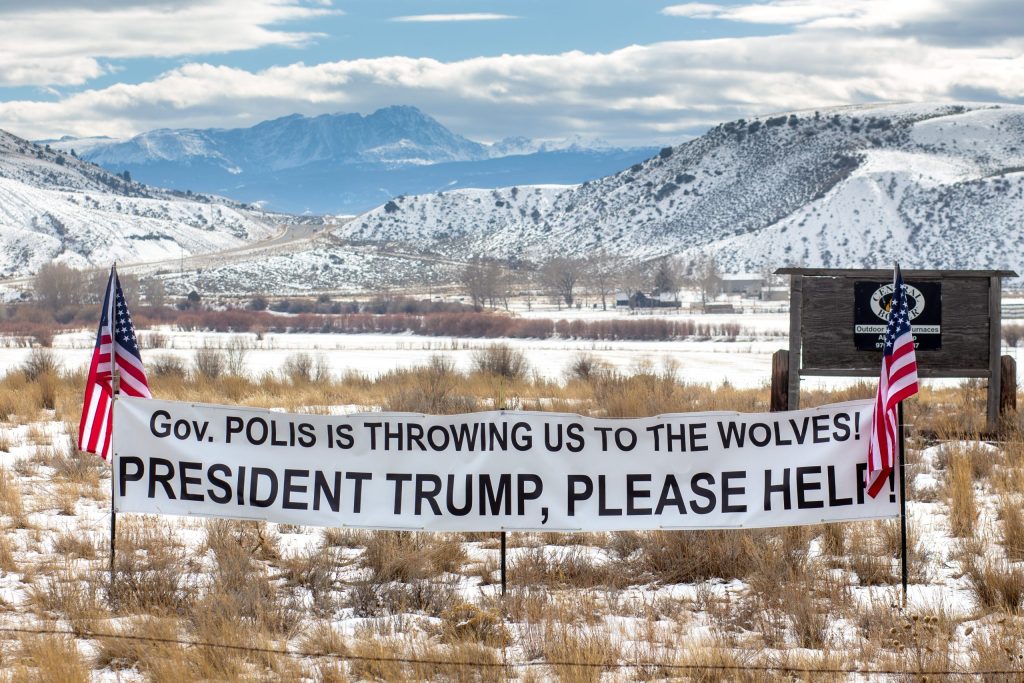
Andrew Maciejewski/Summit Daily News archive
As the U.S. Department of the Interior implements an executive order from President Donald Trump, it has started a 15-day review of Colorado’s agreements with the U.S. Fish and Wildlife Service to manage gray wolves in the state.
Trump’s Sept. 4 “Supporting America’s Ranchers” order directed the Interior Department to consider — and if necessary, take steps toward — delisting or downlisting gray wolves from the federal Endangered Species Act, among other requests related to protecting livestock and producers from predation. The executive order also directed the U.S. Department of Agriculture to take wolf-related actions, which so far have included sending a letter to all states with wolves to encourage them to review state-level protections of the predators.
On Oct. 27, Interior Secretary Doug Burgum signed his own order in line with the president’s, stating in a news release that it “cuts through bureaucratic red tape to deliver certainty and flexibility for our nation’s ranchers.”
While Burgum’s order includes plans to expand grazing opportunities, streamline permitting and increase transparency, it also includes a specific review of Colorado’s wolf reintroduction under the order’s guidance to help ranchers protect their livestock from predators.
It gives the U.S. Fish and Wildlife Service 15 days to review its Memorandum of Understanding and 10(j) rule with the state of Colorado — both of which were issued in 2023 to grant the state management authority to restore and conserve gray wolves as a federally-endangered species.
This review, the order adds, is meant to “(a) ensure that ranchers are adequately considered and compensated for livestock losses and (b) whether there has been full compliance with the program requirements and (c) evaluate program modifications that will address other problems identified by ranchers.”
It continues to direct Fish and Wildlife to prepare a report “with recommendations for program improvement including an update to the Memorandum of Understanding between the Department of the Interior and the State of Colorado.”
Asked whether Colorado had been made aware that the review would be taking place, Luke Perkins, the public information officer with Colorado Parks and Wildlife, said “no.”
According to Perkins, the state agency has “not yet” been asked to be involved in the review, but that “we want to be part of the review process.” He added that until Parks and Wildlife is involved, the agency “cannot speculate on an outcome.”
In 2020, Colorado voters mandated that Parks and Wildlife reintroduce and build a self-sustaining population of gray wolves starting in December 2023. It also required the state agency to help producers prevent wolf conflicts and compensate them for livestock losses. Using its wolf plan as a guide, Colorado Parks and Wildlife released 25 wolves in the program’s first two years — with several packs forming and reproducing since — and created a program to compensate producers.
Gray wolves have been listed as federally endangered under the Endangered Species Act since reintroduction began. While the act grants primary oversight to the U.S. Fish and Wildlife Service over the conservation of any species federally listed as endangered or threatened, the special 10(j) rule identified wolves in Colorado as a “nonessential, experimental population” in the state and gave Parks and Wildlife certain capabilities, including to kill wolves as a management tool.
The authority for Parks and Wildlife to lead Colorado’s management of the wolves was granted in the separate memorandum, in which Fish and Wildlife approved Colorado’s wolf plan and indicated the state has demonstrated it “has the authority and management capability to conserve gray wolves.”
This is not the first time the federal government has threatened to get involved with Colorado’s wolf program or to alter these agreements since Trump took office for his second term.
In December, Burgum warned on X that the federal government would step in if Colorado “does not get control of the wolves immediately.”
On the same day, Fish and Wildlife Director Brian Nesvik sent a letter to Parks and Wildlife questioning the state agency’s decision-making, threatening to terminate the agreement and take over the program should the state agency not comply with a request for information.
The federal agency requested a complete reporting of all gray wolf conservation and management activities from the start of reintroduction in December 2023, as well as a narrative summary and documentation regarding Parks and Wildlife’s January 2025 release of wolves imported from Canada and a December 2025 release of a wolf from a pack with a confirmed history of repeated depredation.
Parks and Wildlife complied with this request in January, submitting over 400 pages of public announcements and presentations, intergovernmental agreements, email correspondence and reports. On Nov. 2, Perkins stated that Parks and Wildlife never received a response from the Interior Department or U.S. Fish and Wildlife Service to these submissions.
On April 6, the Fish and Wildlife Service also published a notice, seeking information and comments on how Colorado Parks and Wildlife is addressing conflicts between wolves and livestock, communicating and implementing the program. Over 1,000 comments were submitted.
Colorado’s reintroduction hit was at what its biologists called an “inflection point” this spring, with success toward building a self-sustaining population hinging on survival rates across wolves of all ages, successful reproduction and pup survival as well as future releases of new wolves.
In September, the agency said it would be pulling back on killing wolves involved in conflict with livestock, citing concerns over several threats — including low adult survival, high proportions of pups and disease potential — facing Colorado’s wolf population. Parks and Wildlife will still consider these euthanizations on a case-by-case basis, but reported it will be more conservative in its determinations after it killed four wolves preying on livestock between Aug. 4 and Sept. 9.
As of Sept. 24, Colorado Parks and Wildlife estimated there are 45 wolves in the state, including 20 pups born to four wolf packs this spring in northwest Colorado. After the change of federal leadership gave Colorado new directions around sourcing wolves, the state has also struggled to find wolves from other states to release for the upcoming winter.
In 2026, the agency has confirmed 40 wolf attacks on livestock as of Oct. 27, according to its online tracker. This has surpassed the 31 events confirmed in 2025, for which Parks and Wildlife has paid just over $47,100 to ranchers in compensation for direct losses. This dollar amount does not include money paid for indirect losses, such as lower weights or pregnancy rates caused by wolves being on the landscape. Parks and Wildlife previously reported that it expected the total compensation for 2025 losses to reach over $1 million.









Support Local Journalism
Support Local Journalism
Readers around Craig and Moffat County make the Craig Press’ work possible. Your financial contribution supports our efforts to deliver quality, locally relevant journalism.
Now more than ever, your support is critical to help us keep our community informed about the evolving coronavirus pandemic and the impact it is having locally. Every contribution, however large or small, will make a difference.
Each donation will be used exclusively for the development and creation of increased news coverage.