Wantland – hope or speculation?
Most of the people who came to Northwest Colorado during the early years of settlement came to make a new home for their families. They were interested in working the land, raising livestock and providing life’s necessities. They were willing to work hard and get dirty to make this place their home.
As with any new area of settlement, though, there were some who saw the open spaces as a chance to make a quick fortune without getting dirty.
Warren R. Given was an established businessman in the growing town of Denver during the late 1800s. He had progressed from working in the mail circulation department of the Denver Times to a business manager for Western Gardens in 1894, and by 1910, at age 35, he had taken a position as an irrigation bond broker.
In May 1908, Given purchased 640 acres of school land from the state of Colorado in the northernmost part of Routt County with an eye to developing an irrigation system for that part of the county. He agreed to pay the state $3,200 for the land at 6 percent interest. He made a 10-percent down payment on the land.
Four days later, the Routt County Development Company contracted with the state for a series of half-section tracts at $1 each.
“The Company is engaged the construction of the Little Snake River Canal System in Routt County : an irrigating ditch in the locality of the tracts of land : and is desirous of furnishing irrigation for the Stat Lands which can be irrigated from said system:” (State of Colorado, County of Routt, Book K pg. 395-398)
Given was the recorded secretary of the development company, and L. C. Greenlee was the president. The document also was signed by the State Board of Land Commissioners and Governor John F. Shafroth, who also happened to be the President of the Board of Land Commissioners.
In the spring of 1910, Given purchased another 160 acres from the state, paying $800 cash.
He wasn’t interested in farming or ranching, but rather, with the combined efforts of his business partners, he began planning a new town on the flat 160 acre tract of land next to the Snake River. Given filed a town plat plan with the state of Colorado on March 12, 1910.
The plan for the new town included a central town square and straight streets. There were to be four numbered streets running east to west. A wider, central Broadway (which would have been Third Street if not named) circled the central diamond-shaped area. Main Street was to run from north to south through the center of the plat and three east to west named streets – Richards, Greenlee, Owens, Cunningham and McAllaster – were to flank each side of it.
Building a town was too big a job for one man, and Given assembled a group of investors to help him with his venture. They were a diverse group of men with different levels of education and affluence, but something brought them together with the scheme of a new town in the new country. Shortly after he filed the plat plan, the men organized a corporation – The Wantland Townsite Company.
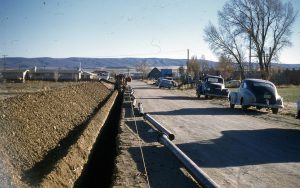
When the company incorporated in July 1910, the men involved hoped to take advantage of the swelling population and the desire of so many to own a piece of land. They also developed an ambitious plan to construct an irrigation ditch to bring water 30 miles to water yards and gardens.
The incorporation papers named five men to act as board members to “manage the affairs and concerns of said company for the first year of its corporate existence.” (State of Colorado Certificate of Incorporation, File 1708 July 22, 1910)
Those named to the board included Charles E. Wantland, who had been a real estate agent in Salt Lake City in the 1890s before relocating to Denver. He was a land agent for the Union Pacific Railroad before becoming a real estate agent again when the town corporation was formed. We don’t know why his name was chosen for the town’s name, but it is possible that he was one of the larger investors in the project.
The second named director was Charles M Heberton, a physician from Boulder. Given had a seat on the board, as did Richard B. McGuire, who was working as a waiter in Denver when the corporation was started. Lewis Greenlee, a treasurer for the City of Denver, no doubt lent his financial knowledge to the project and was the president of the Routt County Development Company.
Two other men signed their names to the incorporation declaration. James J. Armstrong was a Scottish immigrant working as a landscape gardener in 1910. It would be easy to imagine him lending a hand to the neat layout of the proposed town. Jessie A. McCune also witnessed the incorporation papers, but little is known about him.
After the streets were laid out and work began on a hotel and other buildings at the town site, the men began to bring prospects to the site in an attempt to fill the streets with homes and businesses. It was a grueling ride by carriage across less than perfect roads, and it seems that most of the people couldn’t see past the sagebrush to the promised town.
The men made an effort to have Wantland named the county seat when Moffat County was split from Routt County in 1911, but their move narrowly was defeated in the state legislature. That loss was a death knell for the town project.
By 1914, Given sold the Townsite land to Alexander Ross, and before too many more years had gone by, the land had been seized for failure to pay taxes and was sold at public auction.
The Wantland Townsite Company dissolved, and its principals moved on to other activities. A.J. McCune became a state engineer with the Colorado Land Settlement Board and was a member of an eastern slope irrigation district finance commission. In 1920, he was listed as the manager of the Overland Ditch and Reservoir Co.
In 1930, Warren Given was a stock broker in Denver. Lewis Greenlee was a bank vice president of a Denver bank in 1920. Available records seem to show that Charles Wantland divorced and left Colorado for Los Angeles where he spent his later years working as a writer.
Today, there are a few foundations and rusting cans scattered about the townsite. Sagebrush has taken the land back, and livestock grazes where the streets of Wantland were laid out, but there is no evidence that, apart from the construction workers, anyone ever lived in Wantland.
Shannan Koucherik may be reached at honeyrockdogs@msn.com.




Support Local Journalism
Support Local Journalism
Readers around Craig and Moffat County make the Craig Press’ work possible. Your financial contribution supports our efforts to deliver quality, locally relevant journalism.
Now more than ever, your support is critical to help us keep our community informed about the evolving coronavirus pandemic and the impact it is having locally. Every contribution, however large or small, will make a difference.
Each donation will be used exclusively for the development and creation of increased news coverage.