Some CPW commissioners believe trust was broken over lack of communication during wolf releases
Sky-Hi News
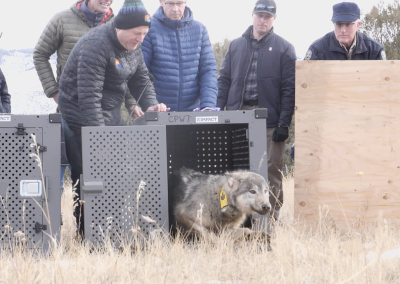
Colorado Park and Wildlife/Courtesy photo
During a Colorado Parks and Wildlife commissioner meeting Wednesday morning in Denver, commissioners spoke about the wolf reintroduction that recently took place in Grand and Summit counties, and some did not hold back their disappointment.
Two commissioners in particular, Marie Haskett from Meeker, who represents sportspersons and outfitters, and Duke Phillip IV, who represents agriculture and is from Colorado Springs, both believe a lack of communication and transparency has led to distrust of the agency in rural communities.
And they both think the wolf reintroduction created animosity between rural and urban areas. While dismayed at the way the wolf releases were rolled out, the commissioners both expressed gratitude for the hard work CPW staff put into making the historic, voter-mandated reintroduction possible.
Haskett was the first to speak about wolves at the Jan. 10 meeting. She called Dec. 18 — the day the first five wolves were released — a “sad day” because commissioners were not notified.
She said that many of the CPW staff who worked tirelessly on the reintroduction were also not made aware. To her knowledge, other members of the legislature and local counties were not alerted about the releases either.
“Even the Grand County commissioner (Merrit Linke) who was on the (Technical Working Group) was not invited to the release, and yet other specific members of the working group were,” Haskett said. “The people who politically drove this issue were present. The divide between rural and urban populations was blown up with this ballot initiative. Now CPW has taken a huge political hit with the public because of these political actions.”
Haskett continued by saying that a lack of transparency caused rifts in the relationships that CPW staff has fostered over many years with ranchers, landowners and citizens on wildlife management issues. She also wants local wildlife managers and biologists to have the ability to communicate with the public about wolf management.
“CPW needs those relationships or it won’t be long before every private gate is locked and CPW is not welcome,” she said.
Phillip then shared with the commission that it really stung when he found out the wolves were released by watching television, especially after he worked for 16 months on the reintroduction program. He talked about how he believes communication and people are at the core of what CPW should be focused on if everyone is going to buy-in to the wolf reintroduction.
“To be so invested in something and have such a good feeling about a plan that we put forward, to find out the day after it had already happened — and me as a commissioner to feel that way — I can’t imagine what the producers and people in the area were feeling; it’s an emotional thing,” said Phillip, who attended the meeting virtually.
He added that he couldn’t comprehend how CPW staff members who put in far more time and work than he did must have felt. He wants the agency to focus on perception and communication going forward, and he agreed with Haskett that the wolf reintroduction has pitted rural and urban communities against each other.
“I felt like we were on a really good path,” Phillips said. “But with how this release was handled, I just see it as a as a big wedge … that just got driven further. Our field staff and agency is going to have to be playing catch up now trying to convince people … it is a lot of perception. And I think we need to be hypersensitive, and the way the release was handled, you know, it was tough.”
The Colorado Commissioner of Agriculture Kate Greenberg was present at the meeting and pivoted to talk about supporting agricultural communities with non-lethal management. She spoke about how the Colorado Department of Agriculture will focus on providing technical assistance to livestock producers. In addition, $2 million of grant money will be used to support non-lethal technical assistance in the state.
The agriculture department will be out in the field supporting CPW, especially on the Western Slope, and there will be joint training between the departments. Greenberg added that the department put in a budget request for three additional staff members that could work in the field with CPW to build up the non-lethal management program.
“We’re really excited about that so that we can have boots on the ground folks out in the field working alongside our livestock communities trying to figure out what does work, and what works for each particular operation,” Greenberg said. “We know one size does not fit all.”
However, not all commissioners at the meeting agreed that the lack of communication reflected disrespect to rural communities. Commissioner Gary Skiba, who lives east of Durango and represents sportspersons, acknowledged that the wolf releases were not perfect, but he thinks the agency did a good job.
“The idea that there was disrespect shown to rural communities … I really sort of push back a little on the idea that there was a lack of respect there,” Skiba said while adding that he hopes there can be forgiveness.
After the opening comments were heard by all the commissioners present, CPW Director Jeff Davis apologized. He immediately clarified that all of the concerns addressed at the meeting were of no fault of the staff working on the release and commended their work.
“My apology comes from me because the area that has the most impact was the ball that I dropped. And so I apologize to all of you for the notification and the transparency pieces,” Davis said. “I’ll just be real clear, like any learning organization we are in the process of doing an internal after action review.”
Davis explained that an internal action review looks at the reintroduction and identifies the successes and failures of the wolf releases, while pinpointing strategies that can be used to improve for the next round of releases. He profusely praised CPW staff while taking the blame himself.
“My apologies for me being the weak link on this operation for CPW,” Davis said. “So, I just I can’t make it clear enough that our staff did their jobs and they did it really darn well. The less spectacular things are mine.”
He added that wolves elicit strong emotions, but CPW must serve the public and that includes considering a spectrum of values, needs and expectations, while delivering the largest amount of benefits to the greatest number of beneficiaries. He reiterated that CPW serves pro-wolf people, anti-wolf people and everyone in between.
“As long as I’m here, which may be hopefully a long time,” he said while laughing nervously, “we want to be that bridge — we are that bridge. I want to say to the rural communities we are going to be there — we are there. We have been there with you all along; the people haven’t changed. These are the same people that are part of your community that have those trusting relationships. And we don’t want a particular species or any of our actions to result in severing those relationships that are so critically important and that all of us have worked so hard to develop.”
To learn more about Colorado’s wolf reintroduction plan, including educational and management resources visit CPW.State.CO.US.
Colorado anglers fear drought will make it ‘hard to keep fish alive’ this summer
Colorado’s trout fisheries could face a difficult summer, impacting the state’s billion-dollar angling industry, as widespread drought conditions drive predictions that streamflows will be well below-average.

Support Local Journalism
Support Local Journalism
Readers around Craig and Moffat County make the Craig Press’ work possible. Your financial contribution supports our efforts to deliver quality, locally relevant journalism.
Now more than ever, your support is critical to help us keep our community informed about the evolving coronavirus pandemic and the impact it is having locally. Every contribution, however large or small, will make a difference.
Each donation will be used exclusively for the development and creation of increased news coverage.