Retired physicist teaches hands-on science at Moffat County elementary schools
Courtesy Photo
At a glance …
• Retired physicist John McConnell visited Maybell and Ridgeview elementary schools last week.
• McConnell and his wife, Audrey, of Grand Junction, led students through hands-on science and math experiments.
• The McConnells present similar programs in other schools in Northwest Colorado and beyond.
Quotable
“You hope that you do things to show them that math and science are cool.”— Retired physicist John McConnell
At a glance …
• Retired physicist John McConnell visited Maybell and Ridgeview elementary schools last week.
• McConnell and his wife, Audrey, of Grand Junction, led students through hands-on science and math experiments.
• The McConnells present similar programs in other schools in Northwest Colorado and beyond.
Quotable
“You hope that you do things to show them that math and science are cool.”— Retired physicist John McConnell
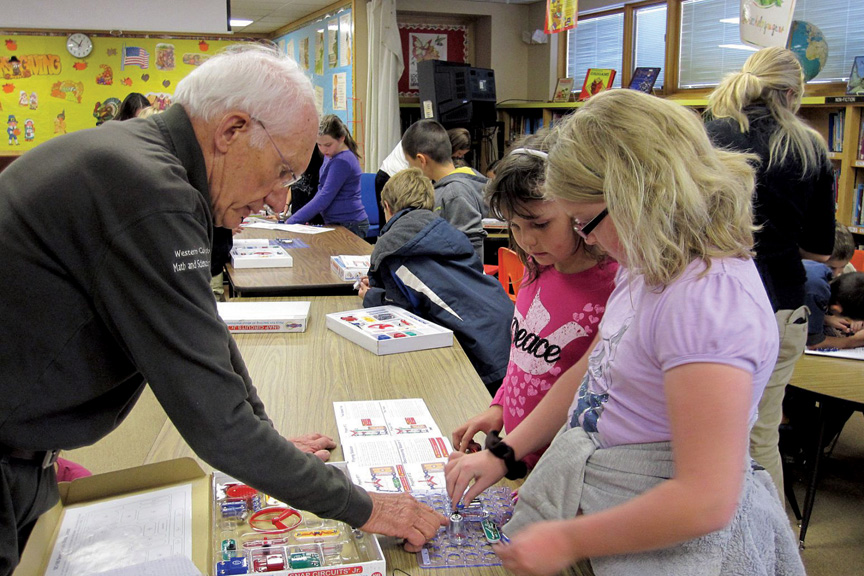
Give retired physicist John McConnell a piece of PVC pipe and an empty pop can, and he can show you a way to teach young children about static electricity.
The experiment is simple. Rub the PVC pipe a little bit, then put it about an inch away from an empty pop can. The can will be attracted to the pipe, which now carries a static charge, he said.
McConnell has a van full of experiments like these, which the Grand Junction resident takes to schools across Northwest Colorado and beyond. Last week, he and his wife, Audrey, stopped at Ridgeview and Maybell elementary schools, where they taught students about everything from static electricity and sound waves to geometry and electrical circuits, according to a news release from Ridgeview.
“All his experiments that he did are hands-on, meaning the kids got to do everything he did,” said Bill Ronis, the sole teacher at Maybell Elementary, a one-room school. “So that creates a lot of interest because they get to do it, and he’s just not demonstrating things.”
From Ronis’ experience, this type of learning works especially well for younger children.
“Kids at that age are very kinesthetic,” he said. “They like to move.”
McConnell doesn’t simply tell students about how static electricity works or how an acid and a base react. He leads them through experiments that help them find the answers for themselves and develop an early interest in science and math along the way.
The purpose behind these experiments is to “pique their interest,” he said. “You hope that you do things to show them that math and science are cool. It’s fun to do.
“It’s not some boring thing you just get out of a book all the time.”
In addition to everyday items like paperclips and plastic straws, McConnell also uses more standard tools of the scientific trade, like pH strips, which students use to learn about the alkaline and acidic principles of baking soda and vinegar, respectively, McConnell said.
Students then mix the two substances together, creating a fizzy reaction that sometimes makes them jump back in surprise, McConnell said.
“Boy, are they excited,” he added.
These experiments are a far cry from the complex science McConnell used to practice. He worked in a nuclear research lab at Iowa State University before continuing his career at Los Alamos National Laboratory in Los Alamos, N.M., he said.
After he retired 21 years ago, he began volunteering to help teach science to fifth-graders at Wingate Elementary School in Grand Junction. It was here that he learned about chemistry — particularly, the kind that develops between mentor and child.
“I really found out I like working with kids,” said McConnell, who also is the founder of the John McConnell Math and Science Center in Grand Junction.
McConnell’s visits are geared mainly toward elementary school students, and there’s a reason for that.
“Personally, I think that you have to start them early,” he said. “I think you need to grab their interest while they’re in elementary school.”
If not, he said, there’s a good chance their interest in math and science will dwindle when they get older.
McConnell is determined to not let that happen. He plans to continue sparking students’ interest in the sciences, one PVC pipe and pop can at a time.


Support Local Journalism
Support Local Journalism
Readers around Craig and Moffat County make the Craig Press’ work possible. Your financial contribution supports our efforts to deliver quality, locally relevant journalism.
Now more than ever, your support is critical to help us keep our community informed about the evolving coronavirus pandemic and the impact it is having locally. Every contribution, however large or small, will make a difference.
Each donation will be used exclusively for the development and creation of increased news coverage.