Jimmy Westlake: Parade of planets begins this week
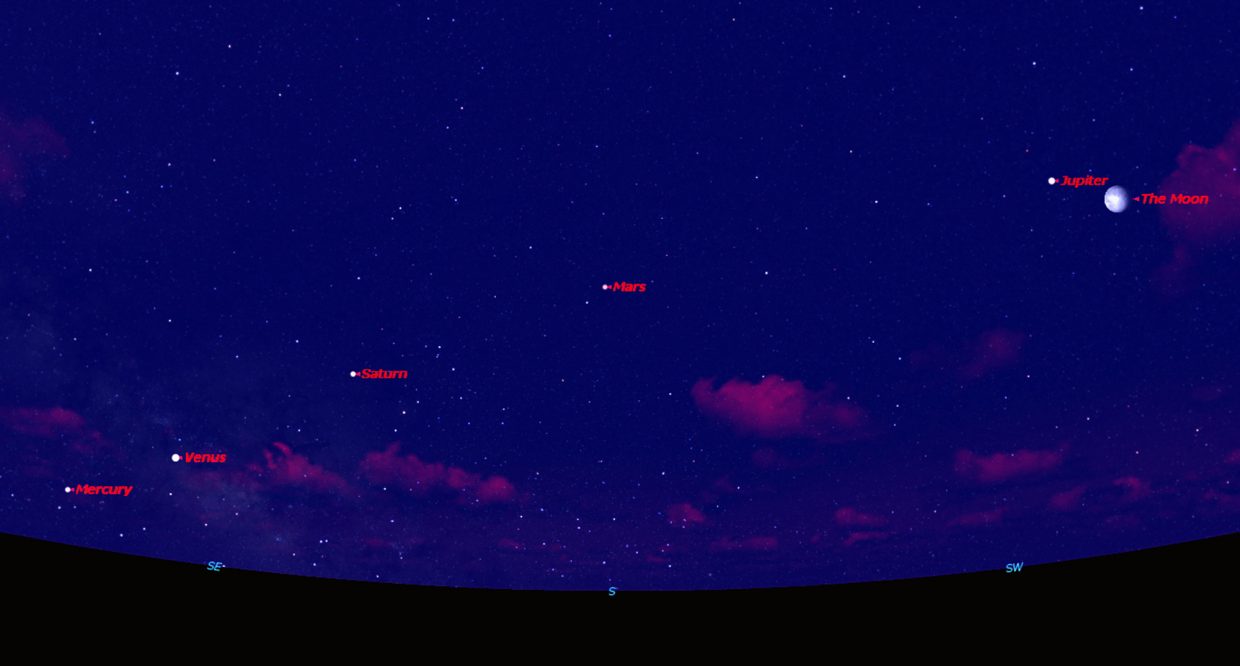
5_Planets_012716
Of the eight planets (maybe nine) in our solar system, only five are easily visible to the unaided eye: Mercury, Venus, Mars, Jupiter and Saturn.
These five planets are among the brightest objects in our night-time sky and are always eye-catching. Humans have watched these wandering stars since prehistoric times.
But, it’s a big sky up there, and catching all five of the naked-eye planets in the sky at the same time is very unusual. The last time it happened was about New Year’s of 2005 — more than a decade ago.
That’s why a special opportunity to see all five planets at the same time before sunrise during the next few weeks makes my “Top 10” list of celestial events this year.
The parade of planets begins in earnest 6 a.m. Wednesday, when the waning gibbous moon appears right beside dazzling Jupiter, high in the southwestern sky.
Moving eastward across the sky from Jupiter, the first bright object to come will be the twinkly blue star Spica. Keep moving to the east and ruddy Mars can be seen nearby. Continue along the same line eastward, and next will be Saturn, hovering above the red star Antares. Keep moving east from Saturn, and then comes brilliant Venus, and then Mercury, both low in the southeastern sky.
By 6:30 a.m., Venus and Mercury will have climbed higher in the sky, but the sunrise glow will take its toll, making little Mercury harder to see. An unobstructed view of the southeastern sky is needed to see Venus and Mercury. Any trees or mountains in that direction will hinder the view.
Watch throughout the next two weeks as the moon parks close to each of the other planets, starting with Mars on Feb. 1, Saturn on Feb. 3 and then the Venus/Mercury pair Feb. 6.
After Feb. 6, the moon will leave the scene, but the five naked-eye planets will remain lined up across the sky through Valentine’s Day, at least. Then, sunrise glow will begin to swallow Venus and Mercury, and the parade of planets will be complete.
The planets line up across the sky similar to pearls on a string because our solar system is flat. The orbits of the planets all lie in nearly the same plane, so they all follow the same path across the sky, through the 12 constellations of the zodiac.
Another opportunity to see all five naked-eye planets at once will happen at dusk next August, but it will be much more challenging, with Venus, Jupiter and Mercury all deeply immersed in the sunset glow.
Professor Jimmy Westlake teaches astronomy and physics at Colorado Mountain College's Alpine Campus. His “Celestial News” column appears weekly in Steamboat Today and his “Cosmic Moment” radio spots can be heard on local radio station KFMU. Check out Westlake’s astrophotography website at jwestlake.com.
Professor Jimmy Westlake teaches astronomy and physics at Colorado Mountain College's Alpine Campus. His “Celestial News” column appears weekly in Steamboat Today and his “Cosmic Moment” radio spots can be heard on local radio station KFMU. Check out Westlake’s astrophotography website at jwestlake.com.
Professor Jimmy Westlake teaches astronomy and physics at Colorado Mountain College’s Alpine Campus. His “Celestial News” column appears weekly in Steamboat Today and his “Cosmic Moment” radio spots can be heard on local radio station KFMU. Check out Westlake’s astrophotography website at jwestlake.com.






Support Local Journalism
Support Local Journalism
Readers around Craig and Moffat County make the Craig Press’ work possible. Your financial contribution supports our efforts to deliver quality, locally relevant journalism.
Now more than ever, your support is critical to help us keep our community informed about the evolving coronavirus pandemic and the impact it is having locally. Every contribution, however large or small, will make a difference.
Each donation will be used exclusively for the development and creation of increased news coverage.