Hayden Generating Station remains completely offline

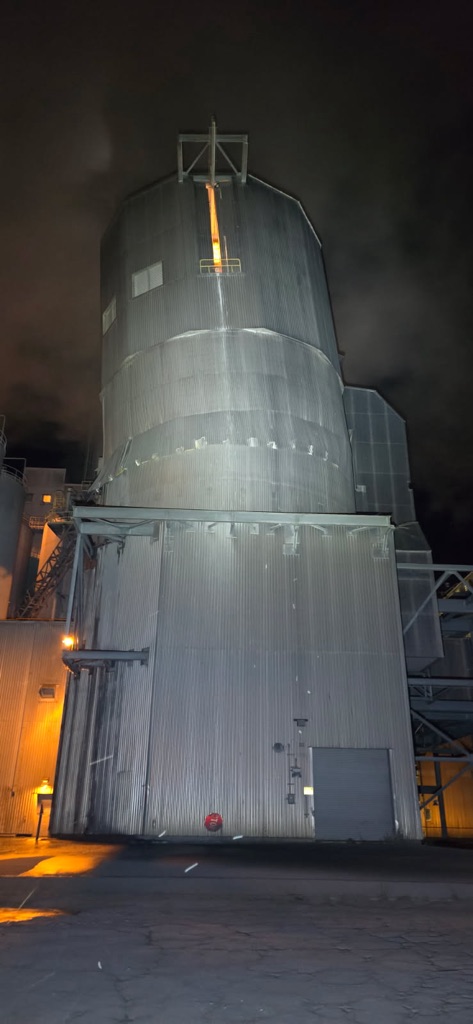
Courtesy photo
A communications spokesperson from Xcel Energy headquarters in Minneapolis provided a short update Friday on the status of the Hayden Generating Station explaining that the entire power plant is not producing electricity at this time.
“It’s our priority to ensure all needed repairs take place and Hayden Unit 2 is ready to safely resume operations before we bring the unit back online,” said Kevin Coss, Xcel senior media relations representative in Minneapolis.
The power plant experienced a shut down on Nov. 29 after the partial collapse of an air pollution scrubber on Unit 2, which was reported along with photographic evidence by a citizen to the Steamboat Pilot and Today.
“As it is designed to do, our control system at Hayden shut down the unit immediately when the scrubber vessel buckled,” Coss said. “We currently have both Unit 1 and Unit 2 at the plant offline while we assess this issue and work to determine what caused it.”
“We do not have an estimated timeline for the repairs on Unit 2,” Coss said. “Both units are offline right now, which means no energy is currently being generated at the plant. Unit 1 is offline while we assess the issue; that does not necessarily mean it will remain offline for the entire duration until Unit 2 is fully repaired.”
“There is no impact to customers’ electric service,” Coss said.
In the meantime, the 61 employees at Hayden station remain on the job, he said.
The partial collapse on Nov. 29 caused no injuries, and “we believe the scrubber vessel is stable,” said Michelle Aguayo, Xcel senior media relations representative in Colorado.
Neither Routt County or state air pollution monitoring stations showed a discernible level of increased air pollution during the week surrounding the partial scrubber collapse on Nov. 29, according to officials at Routt County Environmental Health and the Colorado Department of Public Health and Environment.
“We at environmental health did not see any noticeable difference in NOx (nitrogen oxides) or SO₂ (sulfur dioxide) or particulate matter pollution as a result of those mechanical issues at the power plant,” Scott Cowman, the Routt County environmental health director, said Tuesday. “I would have concerns if they did not shut the unit down. I think they would have trouble with complying with those air quality standards if they did not shut that unit down. They have an air quality permit that they need to comply with.”
Several town of Hayden and Routt County leaders contacted last week expressed disappointment that Xcel officials did not notify local leaders of the mechanical problem and partial plant shutdown.
Kate Malloy, communications supervisor with the CDPHE Air Pollution Control Division, said Xcel officials are not required to notify the division unless air pollution spikes above permitted levels.
“They are not required to do so unless the shutdown results in emissions above permitted levels or other deviations from applicable requirements,” Malloy said Dec. 17. “We do not typically monitor repair activities unless they are associated with substantially elevated emissions beyond permitted levels or additional issues occur.”
Cowman said the county maintains two air quality monitoring stations including at Routt County Fairgrounds almost 4 linear miles west and typically upwind of Hayden Station, as well as on top of the Routt County Health and Human Services building in downtown Steamboat, approximately 19 linear miles from Hayden Station.
“The effects probably diminish the further you get away from the source,” Cowman said of the station monitoring capabilities.
Cowman pointed citizens to the county’s online air quality dashboard established this spring to view pollution information, at Co.Routt.Co.US/160/Air-Quality. The two Routt County Air Quality Stations monitor four air pollutants – NO2, SO2, ozone and particulate matter 2.5.
“The recent mechanical issue at Hayden Station that led to a temporary unit shutdown had the potential to cause short-term changes in emissions like nitrogen dioxide and sulfur dioxide, but available monitoring did not show any detectable changes in air quality or anything that would be harmful to the community,” Cowman explained.
“How much of these pollutants show up at ground level depends on factors like fuel type, how the unit was operating, whether pollution controls were working as designed, how long the issue lasted, and weather conditions such as wind and atmospheric mixing,” Cowman noted. “Other local sources, like vehicle emissions and home heating, also play a role but are relatively limited in Routt County.”
Hayden Station Unit 2, which opened in 1976, has a reported electricity production peak capacity of 262 megawatts. The two units at Hayden Station utilize steam-driven turbine generation with boilers using pulverized coal.
In past decades, the plant had the potential to submit haze-forming pollution. However, air pollution control devices were added following a 1993 lawsuit originally launched by the Sierra Club that was settled in 1996.
According to Xcel, scrubber installation at Hayden Station to meet environmental standards was a multi-phase project including installing baghouses and scrubbers. In 1999, large baghouses, or giant filters, for capturing particulates and fly ash, and initial scrubbers were installed at a cost of some $100 million. Further emissions controls such as selective catalytic reduction were completed by 2016.
A May 1996 media release from the U.S. Environmental Protection Agency announced the $140 million pollution control settlement under the Clean Air Act levied against Colorado Public Service Co. (an Xcel predecessor) and its partners “that will dramatically reduce air pollution and protect public health.”
At that time in 1996, “the Hayden power plant currently has no emission controls for SO2 or NOx and ineffective controls for small particulate pollution,” according to the EPA release.
“Additionally, the settlement will improve the quality of lakes and streams and increase visibility in northwestern Colorado’s scenic and environmentally sensitive Mount Zirkel Wilderness Area. This settlement will reduce air pollution by more than 20,000 tons per year, bringing clearer skies, cleaner lakes and streams, and better health to the people of Colorado,” per the release.
“The consent decree, filed by the U.S. Department of Justice in U.S. District Court in Denver, resolves allegations made by the federal government, the state of Colorado, and the Sierra Club, that PSC’s Hayden power station violated Clean Air Act pollution limits, obscured visibility and increased acid levels in snow in the wilderness area, situated 19 miles downwind from the facility,” according to the 1996 release. “When the snow melts in early spring, it can result in an ‘acid pulse’ into rivers and lakes, which can kill fish and flora in the wilderness area.”





Support Local Journalism
Support Local Journalism
Readers around Craig and Moffat County make the Craig Press’ work possible. Your financial contribution supports our efforts to deliver quality, locally relevant journalism.
Now more than ever, your support is critical to help us keep our community informed about the evolving coronavirus pandemic and the impact it is having locally. Every contribution, however large or small, will make a difference.
Each donation will be used exclusively for the development and creation of increased news coverage.