Faith: Seen and unseen
Faith

As the song goes, “We are living in a material world.” (I’ll leave it there.) We live in a world of “stuff” — matter, physical objects, some living, some not. Our day to day experience involves our bodies and our interaction through our senses of the material world around us — rocks, dirt, trees, water, other living creatures from squirrels to elephants. I know I’m stating the obvious, but if we’re honest, there’s more going on with us than our “mere” physicality.
We also know, through our actual experience, that there are some things that cannot be reduced or explained by the material world around us. To be sure, we may describe what happens physiologically or neurologically when we experience such things as love or beauty, or “awe.” But such descriptions of what goes on with us physically don’t fully account for what lies behind, or above, such experiences.
Even in our “material” world, we continue to use language from an earlier time. We use phrases like, “team spirit,” or “esprit de corps.” We throw phrases around like, “I’m very spiritual, but not religious.” Instinctively, even if we’re not “religious,” we recognize that there is a depth to us as human beings that we still call “spiritual.” We recognize that there is something about our world that connects to something else, something greater, something transcendent, that is inherently spiritual.
The scientific revolution gave us the ability to understand our world like never before. It led to amazing advances that have alleviated hardship and suffering at levels never experienced in the history of humanity. For this we should be enormously grateful.
But such advancement in our understanding of the material world also came at a cost. Our forebears, across traditions, understood the world as “enchanted” by spiritual realities. The world was not just what was visible, but was also the domain in which invisible, unseen realities were at work. Indeed, human beings, at all times and all places, have recognized something of the spiritual realities underlying our existence. The very fact that we search for meaning, for truth, for purpose, manifests our recognition that we are not just meat and bones. There’s something more.
In the Orthodox Christian tradition, we understand our world as created by God and sustained by Him. As human persons, we are created in His image and likeness, and thus have a connection with Him, as does the whole created order. It’s not that we have two “worlds,” one material and one spiritual; rather, the created world, with all its materiality, is sustained and upheld by the Spirit of God who brings order out of chaos, life out of death.
All of this is to say that there is a unity between the material and the spiritual, and when that unity is ignored or rent asunder, we find ourselves in disorder, in chaos. One might argue that this is a pretty good definition of sin — we separate ourselves from God by denying the reality of His presence and Lordship over our embodied lives. Like Adam and Eve in Paradise, we live and act as if God has left the room, and we attempt to live under our own power, detached from the reality of God’s sustaining Presence.
Thankfully, God does not leave us to our own devices, as we desperately try to find meaning and purpose in our small lives that are all too short and fraught with suffering. Rather, God in His love has come to us in Jesus Christ, to heal the rift between the material and the spiritual; to restore the proper relationship between all God has created and Himself. In Christ, the material, including us, is made holy again. We are invited to enter into the Divine Life of God, made possible because God has joined Himself with us in Jesus Christ.
In Christ, we begin to see our world and our experience in it as fundamentally spiritual, fundamentally holy, as we offer our selves and our world to Him. In Christ, there is no distinction between the “material” and the “spiritual.” Rather, all of life is the domain of the Holy. All of life is offered to God as an offering of praise and thanksgiving, and by God’s Spirit, is made holy.
Yes, we do live in a material world, but that world is shot-through with the Glory of God as revealed in the person of Jesus Christ, who lived among us, died, and bodily rose again, giving life to the world. Our salvation in Christ is not an escape from our embodied world; rather, it is the redemption of our souls and bodies, a restoration of all things as God intended them to be — a new heaven and a new earth, in which we become the children of God.
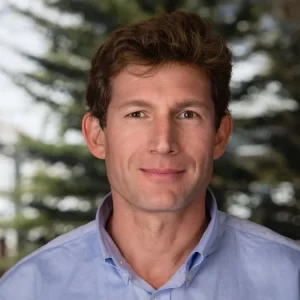
Fr. David Henderson is priest at St. John the Baptist Orthodox Christian Church. He can be reached at davidwh787@gmail.com.

Support Local Journalism
Support Local Journalism
Readers around Craig and Moffat County make the Craig Press’ work possible. Your financial contribution supports our efforts to deliver quality, locally relevant journalism.
Now more than ever, your support is critical to help us keep our community informed about the evolving coronavirus pandemic and the impact it is having locally. Every contribution, however large or small, will make a difference.
Each donation will be used exclusively for the development and creation of increased news coverage.