Lawmakers reject plan to boost transparency around Colorado wolf release costs
Colorado’s Department of Natural Resources officials said this information was already included in several reports

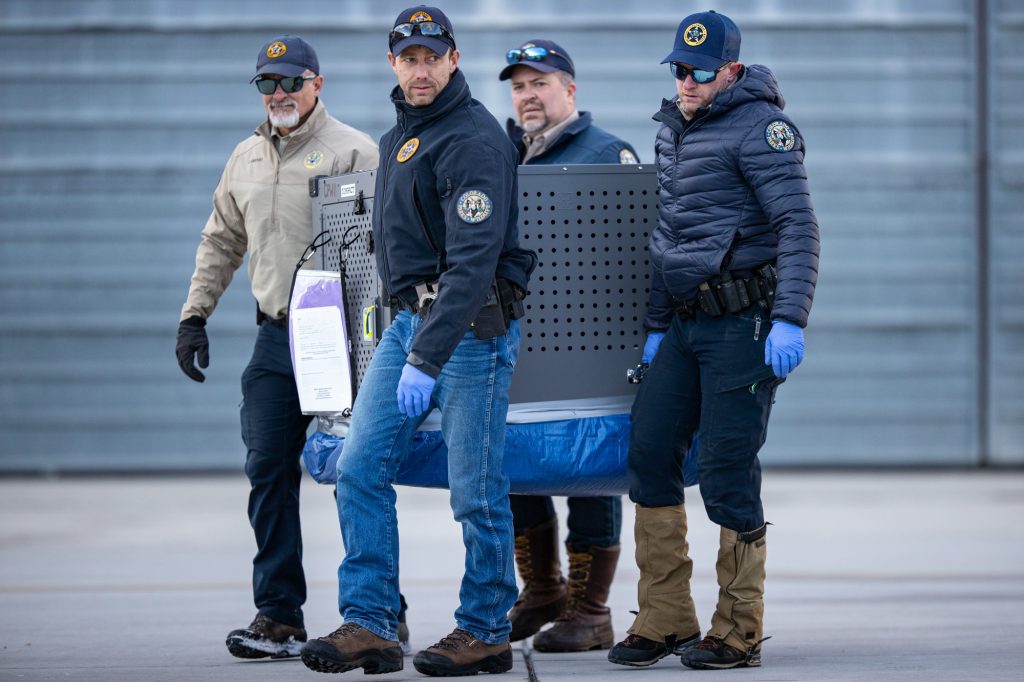
Colorado Parks and Wildlife/Courtesy Photo
Lawmakers shot down an idea to increase transparency around Colorado’s wolf-related costs, as the state’s wildlife agency nearly doubled its previous estimates for what wolf capture and releases cost.
Colorado’s Joint Budget Committee discussed Colorado Parks and Wildlife’s wolf-related budget during a meeting on Monday, March 23. Amid ongoing transparency concerns surrounding the state’s wolf reintroduction program, committee staff introduced an idea to create a separate budget line item that would list the costs associated with capturing and releasing new wolves.
This idea was ultimately rejected, with lawmakers settling on using existing reporting requirements to meet the goals around accountability.
Currently, wolf translocation expenses are lumped into a line item with all of the agency’s wildlife-related expenses on the budget. Separating the wolf translocation costs from its existing line in the state budget would not require additional allocation of funds from the general fund.
Kelly Shen, a Joint Budget Committee staff member, told lawmakers that separating out this budget item “could allow for increased transparency and clarity,” but that the Department of Natural Resources, which oversees Parks and Wildlife, had a “strong preference” against doing so.
“The department has indicated that the appropriation already has a decent amount of transparency and reporting associated with it,” Shen said, listing two budget footnotes, an annual depredation compensation report, an annual wolf report and an annual expense report requested by the committee among the current documentation requirements.
Parks and Wildlife receives an annual allocation of $2.1 million from Colorado’s General Fund for the wolf reintroduction, which was initiated by a ballot measure in 2020. In 2023, lawmakers also created a Wolf Depredation Compensation Fund — filled by an annual $350,000 general fund allocation to compensate ranchers for livestock losses related to wolves.
During Monday’s committee meeting, Parks and Wildlife said that if it were to create a separate line for wolf translocation costs, it recommended an appropriation of $450,000. This would not be a new appropriation, but would come out of the $2.1 million it already receives for wolves.
This amount was nearly twice as much as the $257,000 Parks and Wildlife spent on the January 2025 capture and release operations in British Columbia, which saw the translocation of 15 wolves to Colorado. According to Shen, this prior amount was “based on a best-case scenario for how a wolf capture would go.”
“The department proposed a higher appropriation for the new line item in order to ensure adequate funds for a less-than-ideal capture scenario (e.g., due to weather delays or other complications),” Shen wrote in the report.
For Rep. Rick Taggart, R-Grand Junction, this new number was part of his stated reason for pushing against creating a new line item.
“I’m not comfortable with the premise that they’ll accept the new line item if we take it to $450,000,” Taggart said. “I feel like they’re bargaining with us, and they set the $263,000 for Senate Bill 5, and now to come back to us and say, ‘Well, that was the best cost situation, and is not really realistic.’ I’m sorry, that just doesn’t hold water to me.”
Lawmakers used the previous translocation amount to craft Senate Bill 5 during the August special session. When passed, it withheld just over $264,000 from Parks and Wildlife’s $2.1 million allocation for one year and redirected the funds to health care subsidies. The bill was meant to encourage a pause in wolf reintroductions amid concerns from producers that not enough was being done to reduce conflict between livestock and the predators.
The amount withheld was based on how much was spent on relocation in 2025, adjusted for inflation, and also barred the agency from using the remaining general fund allocation for releases, requiring any releases during the 2025-26 fiscal year to be paid by gifts or grants.
Parks and Wildlife ultimately did not release any wolves this winter due to challenges with sourcing, rather than costs. The decision came after a change in leadership and direction from the U.S. Fish and Wildlife Service.
Is more accountability needed?
While the Joint Budget Committee rejected the creation of a new line item, some lawmakers still wanted greater accountability within the existing reporting requirements for Parks and Wildlife when it comes to wolves.
“I want to make sure that they don’t have spending authority until they’ve done their management like they’re supposed to be doing,” said Sen. Barbara Kirkmeyer, R-Brighton. “Where’s the transparency to ensure that there is a pause until they’ve met their management requirement?”
The pause and management requirement refers to a footnote that lawmakers put into last year’s budget. The footnote requests that Parks and Wildlife not spend any of its general fund allocation on wolf reintroductions “unless and until” preventative measures “are implemented to the highest degree possible to assist owners of livestock in preventing and resolving conflicts between gray wolves and livestock.”
It is one of two wolf-related footnotes included in the state budget. The second states that the $2.1 million allocation “be used for the implementation of Proposition 114 for the reintroduction and management of gray wolves.”
Both footnotes are expected to remain in the budget for the upcoming 2026-27 fiscal year.
According to Shen, these budget footnotes are one mechanism lawmakers can use to create the transparency sought by Kirkmeyer. Footnotes, however, only express the General Assembly’s intent on how funds can be spent. Any specific requirements would have to be legislated, Shen added.
The Joint Budget Committee also requires that the Department of Natural Resources and Parks and Wildlife submit an annual report.
The committee approved some changes to the report on Monday. The report specifically requests “information on whether the Department of Natural Resources has spent or is planning to spend state funding on new wolf releases” as well as how much it spent each month on wolf-related personal services, operating, rancher compensation and conflict minimization.
In last year’s report, Parks and Wildlife reported that it had spent $3 million on the wolf program from January to July 2025. The largest portion, around $1.4 million, was spent on personnel. Around $933,000 was spent on operating costs, $604,191 on compensation for producers and around $94,000 on conflict minimization. In addition to the general fund allocation, the agency receives funds from the Born to be Wild wolf license plate and other sources.





Support Local Journalism
Support Local Journalism
Readers around Craig and Moffat County make the Craig Press’ work possible. Your financial contribution supports our efforts to deliver quality, locally relevant journalism.
Now more than ever, your support is critical to help us keep our community informed about the evolving coronavirus pandemic and the impact it is having locally. Every contribution, however large or small, will make a difference.
Each donation will be used exclusively for the development and creation of increased news coverage.