Northwest Colorado elk herds bounce back three years after tough winter
As a result, CPW is proposing an increase in hunting licenses in the region

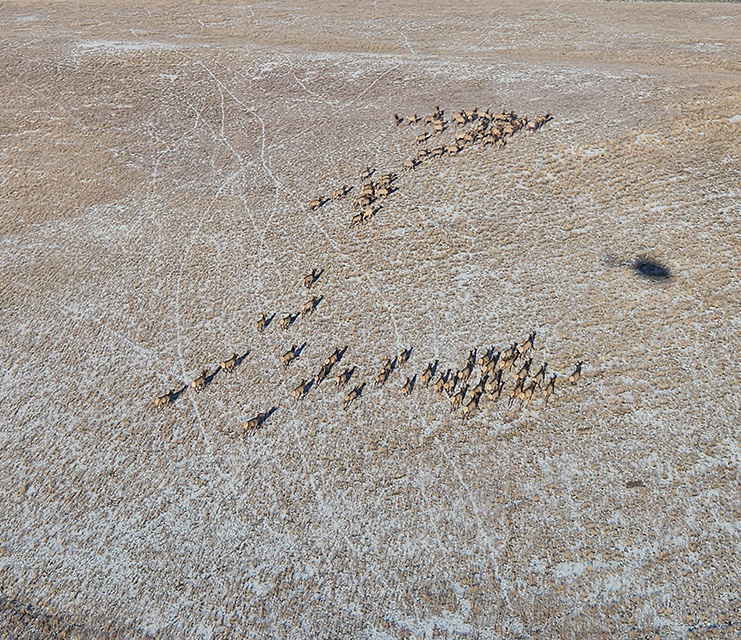
Colorado Parks and Wildlife/Courtesy Photo
Elk herds in northwest Colorado between Meeker and Steamboat Springs have rebounded after a punishing winter in 2022-23 decimated some of the state’s largest herds.
With the recovery, Colorado Parks and Wildlife staff will be recommending a significant increase in hunting licenses within the area’s herds.
“Looking at the landscape today, it’s hard to believe that just three years ago we were experiencing the worst winter we had seen in 70 years,” said Darby Finley, Colorado Parks and Wildlife’s terrestrial biologist in Meeker, in a news release. “That spring, we saw some of the lowest survival rates ever recorded by CPW biologists. In some areas, elk populations north of Craig were reduced by half. Today, we are seeing a much different picture with elk population numbers.”
The recovery was documented by the wildlife agency’s annual winter classification flights, which it uses to estimate population sizes and track survival and birth rates of both deer and elk herds. This winter, Parks and Wildlife reported that the Bears Ears and White River elk herds had returned to their population targets for the first time since the 2022-23 winter.
That winter brought significant snow accumulation and crusted snow conditions that challenged animals’ ability to travel and conserve energy, leading to widespread malnutrition and an abnormally large die-off of the area’s calves and fawns, as well as older animals and mature bulls and bucks that had already had their body condition depleted after the fall rut. The conditions were a big hit to ungulate herds that have historically been among the most productive in Colorado and the country.
Per the agency’s management plans, the Bears Ears herd’s target population is between 15,000 and 18,000 animals, the White River herd between 32,000 and 39,000. At the end of 2023, Parks and Wildlife estimated the Bears Ears herd at around 10,500 elk and the White River around 30,300.
While this year’s abnormally dry and warm winter made it more difficult for area biologists to count the ungulates that blend into a barren landscape, it also changed how the elk were distributed.
“The lack of snow made it difficult to count elk blending into the sagebrush-covered hills,” said Becca De Vergie, Parks and Wildlife’s terrestrial biologist in Craig, in a news release. “Despite this challenge, and thanks to a skilled pilot, we were still able to observe and classify thousands of elk in overall good body condition.”

In the Bears Ears herd — which spans a region north of Steamboat Springs and Craig — area biologists reported a significant shift in elk distribution due to the unusual lack of snow cover, particularly at low elevations where there was almost no snow. Despite low snowpack, staff reported that several thousand elk still migrated into the typical winter range in the western portion of the management region, but that more elk than usual remained on the eastern side of Highway 13.
During the flights, Parks and Wildlife staff classified — identifying gender and age — a total of 10,203 elk, with more observed but difficult to classify given the dry conditions. In one group, staff classified 2,578 elk.
In the White River herd — which covers the area south of Highway 40 toward Glenwood Springs and between Meeker and Steamboat Springs — the agency reported that elk numbers were spread across all elevations. During flights in the White River and Williams Fork drainages, over 18,500 elk were observed, marking a slight increase from the previous year and indicating a consistent upward trend in elk populations, which the agency attributes to the mild winter conditions over the past three years.
“Spike bulls [young bulls with antler beams with no tines] serve as important indicators of the previous year’s calf survival,” Finley said. “As we have seen, calf ratios continue to be trending in a positive direction with excellent spike bull ratios in the past two years, indicating high survival and recruitment of calves into the yearling age class.”
Hunting licenses in the northwest are expected to increase
With the northwest elk herds recovering from the punishing 2022-23 winter, Parks and Wildlife is proposing an increase in hunting licenses for the region.
The agency significantly reduced the hunting opportunity in these herds following that winter. This included reductions in season dates for the rifle season and cuts of between 60% and 89% in license numbers for archery, muzzleloader and rifle seasons.
As the herds started to show signs of recovery in 2024 and 2025, the agency began to slowly increase the number of licenses sold. With the data from the classification flights this winter, the northwest region staff is preparing to propose a significant increase in the number of antlerless elk licenses and a return to over-the-counter sales — something it had removed — for bull tags during the second and third rifle seasons.
According to the agency, these recommendations are based on the Herd Management Plan objectives, harvest data collected from the previous year’s hunting season, classification data collected in the late fall and winter, and survival data collected from deer and elk monitoring areas in select units. The license number recommendations will be presented to the Parks and Wildlife Commission at its May meeting in Grand Junction.
“With the Primary Draw application period closing on April 7, we wanted to make sure that we are getting this information out to hunters, especially those who chose to hunt in other areas to help in our efforts to increase the elk population,” said Mike Swaro, Parks and Wildlife Meeker area wildlife manager. “We knew that decision and the decision to slowly increase licenses in 2024 and 2025 would not only impact hunters, but also the local economy; however, we have seen nothing but support for these decisions in the last three years.”



Support Local Journalism
Support Local Journalism
Readers around Craig and Moffat County make the Craig Press’ work possible. Your financial contribution supports our efforts to deliver quality, locally relevant journalism.
Now more than ever, your support is critical to help us keep our community informed about the evolving coronavirus pandemic and the impact it is having locally. Every contribution, however large or small, will make a difference.
Each donation will be used exclusively for the development and creation of increased news coverage.